Categories
Blogs Computere og Internet Hackers Historier/Stories Kim Blog (English) Open Source Technology

BarCampCopenhagen: Party for your right to geek

BarCampCopenhagen LogoAs it might have caught your attention, the second BarCampCopenhagen took place this Friday (25th of January 2008), and there was great energy in the building. It’s evident that there’s a strong interest in having an event like BarCamp in Copenhagen, and it was inspiring, just to try to tap into that energy.

On the practical level, BarCamp was a great success, especially thanks to generousity of Beaconware (Troels, Allan and Kimmy) and of course Toothless Tiger (Henriette and Thomas) and Laura who moderated the “Kangaroo?” sessions, and thanks to the sponsorship from BridgeIT (my employeer), the event could be taken to such a high level, without having to charge the participants.

I must say that I’m amazed by the group of dedicated and interesting people that showed up, this is what they do for a living, but they’re also interested in sharing their ideas openly – thank you all!

To me the greatest moments were that I, finally, got to meet some people, that I’ve been following online, in real life.

If you have to criticise the event a little, I think we had some “growing pains” – in 2006 the event was more intimate, since we could all fit around one table, this meant that we could have more of an “open space” type of event, and that is the format that I prefer.

Civilisation 0.1

I did a presentation – Civilisation 0.1 – a pun on Tor Nørretranders Civilsation 2.0 – and I had some (understatement) difficulty making my points, that most likely had something to do with the fact that I had the wrong audience, since they’re all “believers”. Knowing the audience is, I believe, number one on the list of things to remember when doing a presentation of any kind, so that was sobering.

Since I failed to get my points across, talking about Pyramids, Archs and Fountains, I’ll try to do better here.

My presentation was inspired by this famous quote from Alan Kay:

If you look at software today, through the lens of the history of engineering, it’s certainly engineering of a sort—but it’s the kind of engineering that people without the concept of the arch did. Most software today is very much like an Egyptian pyramid with millions of bricks piled on top of each other, with no structural integrity, but just done by brute force and thousands of slaves.

My argument is that we’ve, so far, been building pyramids, but that we’ve invented the arch.

“The Pyramid”, is current ICT businesses, and their monopolistic pratices
“The Arch”, is “open source” and MM(O)C (Massively, Multiuser (Online) Collaboration)
“The Aqueducts” is the “Internet”
“The fountains” and “Temples” are the “things” we can build using “the arch” and the tremendously powerful tools and technologies we have in our hands.

I also tried to make these points:

  • Basic infrastructure should be free
  • We’re busy building “Pyramids” – using brute force
  • Civilisation is still in beta
  • We actually have the power to change things – get involved
  • The beer isn’t free – it will cost money
  • Join the revolution

Like I said, and this was obvious if you attended, I wasn’t too good at getting these points through, and to me, one of the main ideas of BarCamp, is to throw ideas on the table, even half baked ones, and have them tested, and even shot down.

My ideas was mostly shot down, and I got a “Emperor’s new clothes” type of comment: “To build the aquaeducts that feeds the fountains you already need an arch”, and someone else pointed out, that “something” was missing going from “The Pyramid” to “The Arch”, did it just appear out of the blue? I didn’t really answer that too well, my point is that the technological equivalent of “The Arch” has been/is being invented, now we can go build the aquaeducts and fountains armed with that knowledge.

Christian Schade was the most sceptical, I need people like him to question my ideas, so thank you Christian.

I’ve actually done a lot of thinking about this, basically I’m a strong believer in utopian ideas – they’ re getting a bit old, and others are better at getting them across than me.

I enjoyed the discussion we had afterwards, and I think that I managed to sell some of my ideas. It’s really quite simple, don’t wait for the revolution to happen, get involved. Like I said, this was the wrong audience, since they’re all already involved in the revolution.

My presentation did align itself, almost perfectly, with the two that followed, those of Christian Schade and Tania Ellis.

The Digital Divide

I was very pleased to, finally, meet Christian Schade, a person that I’ve been following for some time. I’ve never met him before, and I only knew him because he, sometime ago, added me as a contact on the online service Jaiku. The way he’s using a microblogging service is very similar to the way I use it, he often posts short messages that only he can understand – like a song that he had some sort of association to.

Christian talked about “the digital divide”, and he started out by stating that the difference between the things he was going to talk about, and the things I talked about, was similar to “the glass is half-full” (me)/”the glass is half empty” (Christian). You could say that I’m the optimist and Christian is the realist.

Christian got his points through, and they’re quite sobering. It’s possible that the younger generation is tech-savy, but they’re basically IT illiterate, yes they know how to use their cellphone, but the Nokia N95 they’re carrying around really is an extremely powerful computer, that they’re just using to TEXT each other.

Since the current trend is that businesses, and the public, use more and more advanced electronic solutions – yes: e-mail qualifies as advanced – IT skills are increasingly important, skills that the educational system isn’t focusing on.

So the digital divide is getting bigger, even in developed countries, and no one seems to care, like Christian pointed out, no one has really seriously looked at the problem with the digital divide, since the Dybkjær report, and when that was issued, they weren’t even sure if the Internet should be the backbone of the “Digital Denmark”.

Of course part of the problem with technology has to do with accessibility, and the general computer really is too complicated to be the basic tool of the digital revolution – no-one should have to know what a firewall and an anti-virus program is…We have a great challenge ahead of us, but no-one seems to care.

I later had a long discussion with Christian, and that was great.

Capitalism with a human face

Tania Ellis at BarCampCopenhagenBarCamp was also graced by Tania Ellis, author of the book “De nye pionerer” (The New Pioneers), and her presentation was about “Social business” – new alliances (oops ;-)) between economics and humanism.

Tania started out by showing a picture of the two choices of careers you’ve had since the 70ies, either you’re the poor, “peace and love” hippie or the greedy business man, but could a third way be emerging? A way where you can merge and/or mix the two, achieving balance and the best of two worlds.

Tania has been giving this a lot of thought, and the examples she found were ranging from the relatively well known (Life Straw), to the “interesting” (Solar Powered Vibrators) to the self-contradictory (Environmentally friendly munitions).

After Christian’s venture into dystopia, Tania presented hope for the future, maybe that is an attribute of the feminine? Afterwards she said that having children certainly helps, something that Christian tried to protest ;-).

I think that Tania managed to put words to my ideas, and present them is a structured manner – the “exercise” of writing a book is probably helpful ;-). Seen as a whole, the pre-dinner presentations by Christian, Tania and me fit extremely well together.

BTW, the splash screen on Tania’s web-site is a quote from Alan Kay. It used to be part of the name of my PowerBook, until I discovered that iTunes Music Store doesn’t like long computer-names, strangely enough the fact that I’ve written about the solution, is the biggest driver of traffic to my blog!

del.icio.us

After these three Kangaroo? tracks, it was time for dinner, and that was just del.icio.us (sorry or soz as I’ve begun to say recently).

Ruby don’t take your love to town

After the break, I decided to stay truer to my Geek roots, and attended the session “Ruby, Rails <meta>?” by Casper Fabricius. This was a great introduction to Ruby. Ruby is definitely very cool – like Neo cool – and I do love interpreted languages. I got a flash-back to the strangest language I’ve ever worked with, APL – an interpreted language that I have mainly used on an IBM mainframe.

One thing I find interesting is the trench-digging, and categorisation of people based on what programming languages they use – with the possible exception of Perl, I haven’t seen a programming language I couldn’t master with relative ease, and I’m, of the conviction that you need to have some general awareness of the different languages and tools that you have at your disposal. If Ruby can get the job done, quicker and faster, you should be allowed to use it.

Unfortunately Denmark is Microsoft country extraordinaire, and .NET is way too dominant. I totally agree with Casper that Reflection in C# is very hard to grasp, within this field Ruby is pure simplicity, and it is just beautiful.

As with all interpreted languages, there are justified performance fears, but if you can deliver solutions quicker, the benefits might overshadow those concerns.

Casper asked the question: so what can you use all this Neo-coolness for? He didn’t really have the time to answer this, but Ruby is being used to build world-class applications.

If you want to get started with Ruby, Casper pitched the web-based Ruby development environment Heroku, and it looks like a good place to start venturing into Ruby coolness. Heroku is in closed beta, but you might be allowed to pass through the Pearly Gates to Ruby coolness, by contacting Casper. [Casper has made me aware (see comments) that Heroku is for Ruby on Rails development, it’s important to distinguish between the two].

Quo-vadis?

The most surprising presentation of the evening, was the presentation by Henrik Biering of the work NETAMIA has done to develop a single-sign-on (SSO) engine, called net-safe. Net-safe is a standards based, plug-able SSO infrastructure, that also contains address validation etc. Running a successful on-line business depends on correct identification of the users, and having valid user data, also means that the users are better behaved.

Henrik knew what he was talking about, based on the experiences of the huge user base of heste-nettet.dk, which he runs. I guess it is obvious, but it really was an eye-opener to me, correct/valid information of users is extremely important, if you want to run a serious web-site.

Everyone in the room was blown away by seeing how polished a product Net-safe is, and when asked how much it had cost to develop it, Henrik answered: hmm, it was something I did together with my son…Amazing!

Embracing the chaos

Henriette talked about how to get businesses to embrace the chaos of the net, it’s a topic she’s writing a book about, and I look very much forward to it.

Engaging the geek warp drive

After all these sessions, I really needed a break, but when Michael Widerkrantz aka. MC, started rearranging the chairs, I just knew that I had to attend.

MC talked about IPv6, and why it’s important. In case you don’t know, IP is the basic communications protocol of the Internet, and the version we’re currently using, has a build-in limit of the number of allowed network addresses, that we’re about to hit, MC said that a recent session of RIPE, estimated that it would happen in less than two years.

I know just a little about networks, but this was mostly over my head, basically I’m sitting somewhere above layer 7, and just want the network to, ahem work, so it beats me why the ISPs just don’t get started rebuilding the infrastructure for IPv6, before it’s too late.

An interesting side-note is that a friend of mine just recently returned from South Africa, and I found out, because her computer acted strangely, that it was because she had been using IPv6 – as seems to be common with developing countries, South Africa is skipping the legacy infrastructure completely, a legacy that will soon hit us, and the entire digital economy, which today is synonymous with the economy.

Thank you

That concluded the official program of BarCamp Copenhagen, and what a great night it was, the air was literally buzzing with energy. Events like this are important, and I hope that this will get people talking and taking similar initiatives.

Categories
Blogs Computere og Internet Education/Undervisning Frivillig arbejde Hackers Historier/Stories Kim Blog (English) NGOs Open Source Resources Technology Undervisning Videnskab

Getting out of beta: The decade of “search” is over – ushering in the decade of “knowledge”

When “Sergei and Larry” approached Yahoo with a brand new concept of a “search engine”, they discovered, to their dismay, that Yahoo wasn’t really interested in “search”, but in selling ads. So Google was born.

How I discovered Google

In 1998 I was doing a search of myself, e.g. ego-surfing, using my preferred search engine, Lycos, and I was stunned to see that the top hits were Usenet groups that contained my name, several of them in fact, but worse: they had names like kimbach.slut.slut.slut etc.

I was a bit upset, especially since I, at that point, was being sued over violation of the marketing law by a former employer – a case that was later thrown out – but I assumed that they might have created those groups, to slander me, and I was quite sure that it wasn’t me that created those groups ;-).

I took a look at the content of the groups, and they had very low traffic, I only found some spam, which was rare in 1998, and someone who asked the question “who is Kim Bach” – a question I’ve pondered myself, but it didn’t look like it had anything to do with me.

Eventually I contacted the hotline of my ISP, Image Scandinavia, and they referred me to…GOOGLE.

Doing a search on Google, I realised that it had nothing to do with me, but that the groups had been created by a disgruntled husband, and Kim Bach was his ex-wife!

I also believe that using Google for the first time, immediately made me drop Lycos. At that point Lycos actually yielded what I’d label “better results”, but that changed quickly.

Google, originally, cracked “the search code”, and the world changed.

How I discovered Wikipedia

This I also remember clearly, and it’s quite interesting, I googled it – indirectly!

3-4 years ago I was trying find the English word for the type of dog, that is called “gravhund” in Danish, I somehow 😉 knew that a literal translation wouldn’t do, since that would have yielded “diggingdog”, “digdog”, “gravedog”.

So a Google search let me to the English Wikipedia article for Dachshund, and that was what I was looking for!

Seeing Wikipedia was an instant eye-opener, and at that point it hadn’t even dawned upon me, that Wikipedia was pure user-generated content!

Google isn’t interested in “knowledge”

Google won by doing a better job, but now “we, the people” are approaching the world with a concept of a “knowledge engine”, only to discover, to our dismay, that for instance Google isn’t really interested in “knowledge”, but in selling ads.

The difference: “we, the people”, will, surprisingly, transform Google from a “search engine” into a “knowledge engine” as well, no matter what Google does. The algorithm Google uses will give preference to “quality”, at least in the long run, and since “we, the people” are so numerous this will happen sooner rather than later.

Case in point, the best SEO strategy I know of is to create a Wikipedia article, try googling the terms I’ve created Wikipedia articles for (for instance: Kim Schumacher, DB03 and DB07).

You’re brainwashed

Google and the big companies have had us, pretty much, brainwashed to think that we have no say. This is reflected by the response to the launch of the Wikia Search engine, on the historic day, January 7th 2008.

Everyone is trying to compare Wikia Search to Google, and that’s missing the point COMPLETELY, and people should read what Wikia Search are writing:

WE KNOW THAT THE QUALITY OF THE SEARCH IS: “PRETTY LOW” (a polite way of saying that it “stinks”)

The way to help change it, is simply to get involved.

Every-time you do a search on Wikia Search, you’re offered the option to edit a “Mini Article” on the search. A “Mini Article” is just a Wiki article, that explains the search term. The “Mini Articles” will be used to improve the search index.

“Unfortunately” people seems to have been using a search on themselves as a benchmark, meaning that a lot of the “Mini Articles” are links to private and small web-sites, but that reflects the community.

Ego-surfing was also one of the first things I did, and the first hit that could be attributed to me was result number 8, and that yielded the photos I’ve taken, that are in the Flickr pool I created for Sjakket, my former place of work.

Is that my major contribution to the world? Well it’s not that far from it, bordering that I believe that it could be.

Getting involved – choose a community to “work” for

My criteria are:

Not for profit, open, free, strong community, sustainable.

The beer isn’t free however, so you’re allowed to make money, but take into consideration how the money is being made, if it is sustainable etc.

Personally I’ve chosen these organisations

  • Kim Bach . Org – My personal Internet presence with community support (some call that a blog ;-))
  • Netværksgruppen i Mjølnerparken – Volunteer to help inner city kids, of non-danish descent, with their homework
  • Æbletræet.dk – A Wiki-based community site dedicated to serving Apple users with content in the Danish Language
  • Wikipedia – The open encyclopaedia
  • Wikia Search – The open search engine

Currently I’m mostly involved in Wikia Search, I’ve found it really intimidating to be a contributor to an Encyclopaedia, so my contributions to Wikipedia have been quite limited, Wikia Search is much less intimidating, and right up my alley.

Where would you put your money (e.g. time)?

In ten years, Google has gone from no to 16.000 employees, but “we, the people” will, in ten years go from no to 6,5 billion, or how many it is that “we” are in 2018.

Where would you put you money (e.g. time)? It will only cost you time, and you’ll be involved in building a beautiful shrine to knowledge and human achievement.

Together we’ll do Google one better: crack the code of “knowledge”, and the world has changed forever.

Free at last, free at last, oh God almighty we’re free at last.

And “we”‘re hiring! No need to submit a resume, come join the fight!

Read more here:

Categories
Blogs Bookmarks Computere og Internet Hackers Kim Blog (English) Open Source Technology

PHP blues – drawing a blank

Software development can be extremely frustrating, and it might be true that the computer only does what you tell it to do, but these days a lot of people, besides yourself, are telling the computer what to do, a fact that complicates matters “somewhat” (understatement of the year).

The following experience documents a case, where I was sure that I wasn’t doing anything wrong, and you could argue that I didn’t, I just didn’t know any better, but thanks to the community I solved the problem.

The setting

I’ve recently begun doing some PHP programming, and I like it a lot, mostly because of all the wonderful community. it’s my gut feeling that I find answers to my questions much faster when I have PHP related questions, compared to .NET questions.

So I was experimenting with generating some XML code from PHP, but when I gave the URL to the W3C validator, it told me that the XML wasn’t well-formed, and that it was the header that was the problem.

I couldn’t see anything wrong, until I took a closer look. There was a mysterious space prefixed the output when I did a View/Source, a space that I for sure knew I didn’t echo. Hmm…

I tried several things, including flushing the output, but nothing helped.

Then it dawned on me: it’s very likely that someone else has had this problem, and if they did, for sure they would have the generosity to share it, so Google to rescue.

I googled: problem php output leading blank, and hit number two yielded this article:

Script for removing blank spaces before and after PHP tags « memento

The solution

It turns out that PHP is quite sensitive if you, by accident, leave prefixed or sufficed blank spaces outside the starting and ending php tags.

So I went through my PHP files, luckily I only have two, made sure there were no leading or trailing blanks og lines, and I get well-formed XML now.

This is a rather annoying bug in, or should I say feature of, PHP, and it exists in both PHP4 and PHP5.

Once again the community came through, without it I’d still be drawing blanks.

And I love the drawing on the memento site, it doesn’t get geekier, and I think I’ll remember to strip leading and trailing blanks now.

I’m still looking for a modern development environment for PHP development (e.g. sourcecode debugging). PHPEclipse, a plug-in for the Eclipse development environment, should provide a relatively modern development environment, even though it’s not up to the standards set by Microsoft VisualStudio, that I’m so accustomed to, Microsoft has spoiled me.

Categories
Blogs Bookmarks Computere og Internet Hackers Historier/Stories Kim Blog (English) Open Source Resources Technology

BarCampCopenhagen: Ça plane pour nous!

BarCampCopenhagen Logo
BarCamp wiki / BarCampCopenhagen

Ça plane pour nous! …. Ça plane pour nous! … Ça plane pour nous! … Ça plane pour nous! Nous! Nous! Nous! Nous! Ça plane pour nous! uh-u-u-uh! Ça plane pour nous!

I går holdt 3/4 af folkene bag den næste BarCampCopenhagen, planlægningsmøde.

Planlægningsmødet var rigtig hyggeligt (som videoen vist viser) og hvis i kigger derovre, så er der bonus: det var nemlig også produktivt (som det faktum, at vi “sådan set” er klar, viser).

Først og fremmest fik vi lagt skinnerne, i form af to højglanspolerede spor, der kommer til at hedde:

  • Geeky sh*t
  • Kangagoo?

Temaet for de to spor bliver hhv. et teknisk (Geeky sh*t) og et ikke-teknisk spor (Kangaroo?). Emytlogien for Geeky sh*t skal findes i den forrige BarCampCopenhagen, for Kangaroo? Siger jeg: FGI!

Hvis du vil “svæve” med os, så sig til! Vi har plads til i alt 50, og det tal nærmer vi os, hvilket vi er benovede over – TAK for interessen.

Ellers har vi brug for stole, sponsorer (mad, drikkevarer, t-shirts, wi-fi udstyr, gaver) og talere (vi er sådan ca. halvt besat).

Næste BarCampCopenhagen afholdes den 25-januar-2008 hos Beaconware, Gl. Kalkbrænderivej 10, kld. 2100 kbh Ø. BarCampCopenhagen afholdes i overensstemmelse med retningslinjerne for afholdelse af en BarCamp, men sådan generelt er de:

The Rules of Bar Camp

  • 1st Rule: You do talk about Bar Camp.
  • 2nd Rule: You do blog about Bar Camp.
  • 3rd Rule: If you want to present, you must write your topic and name in a presentation slot.
  • 4th Rule: Only three word intros.
  • 5th Rule: As many presentations at a time as facilities allow for.
  • 6th Rule: No pre-scheduled presentations, no tourists.
  • 7th Rule: Presentations will go on as long as they have to or until they run into another presentation slot.
  • 8th Rule: If this is your first time at BarCamp, you HAVE to present. (Ok, you don’t really HAVE to, but try to find someone to present with, or at least ask questions and be an interactive participant.)

by Tantek Çelik as parodied from The Rules of Fight Club.

Categories
Blogs Computere og Internet Hackers Kim Blog (English) Open Source Technology

Drupal:Reloaded: Upon this “rock” I will build my “church”

Drupal.OrgAfter a while being away from Drupal CMS, and struggling with a, IMHO, buggy version 5.0 earlier this year, I’ve come back to visit this old friend, and I’m very happy to be back.

Firstly: I must say that the current version 5.3 of Drupal is rock solid, and that I have renewed confidence in Drupal.

My revisiting Drupal has, in part, been sparked by a rather depressing talk on the Drupal Denmark mailing list. The community seemed to be withering away, and I was sad to hear that.

Personally I’m back from a long break from ICT work, and I think that I did a fair share of volunteer work, while we were trying to set up the group last year.

Another reason I’m back, is that I have a number of web-projects coming up, and I’ve long considered making Drupal the foundation of a majority of my future web projects, you might not notice, since my projects, most likely, won’t look much like Drupal.

You might also want to check my del.icio.us links tagged with Drupal, I’m currently looking into integration issues, but I’ll also be sharing module recommendations, and I’ll, most likely, contribute localisation files back to the community – it’s good to be back.

Drupal: Upon this “rock” I will build my “church”

Categories
'i dag' (Danish) Blogs Hackers Historier/Stories Humor Manic Panic

Ward drive? Been there, done that!

Kim Bach کیم پاک:
Det er pokkers…jeg har ideerne, ved stort set hvordan alt skal laves, jeg har bare ikke energien
Det er da mega frustrerende at vi sidder i hver vores hjørne af verden og spilder MASSER af tid

Jamen, Kim.. Det er bare om at udnytte al din viden! Med mine evner til at stille spørgsmål og dine evner til at svare – hvem ved … en kur mod kræft er måske målet..

Kim Bach کیم پاک:
Kan nøjes med Warp drive
(og du ved godt at de kodnings spørgsmål du stiller er sådan < 101 niveau )

Ja, I know.. Sorry..
Jeg ved godt at jeg ikke ligefrem udfordrer dig..
Men jeg lover at vi sigter efter ward drive næste gang..

Kim Bach کیم پاک:
Ward drive? been there done that LOL
Det endte med at jeg “lånte” nogle penge til en pige der påstod at hun havde været Side 9 pige og på forsiden af V-MAX
Oh well hun skrev i min “poesi-bog” så noget fik jeg da ud af det

Categories
Blogs Hackers Historier/Stories IT Guruer Kim Blog (English) Photography Rumforskning Videnskab

Happy birthday dear Sputnik, Space Ship One, FSF, Russian democracy and brother dearest

The famous Earthrise pictureI’m so envious my dear brother, this day October 4th – your birthday – seems to coincide with one of the most important days in modern civilisation, a day that has importance for exploration of space, as well as important steps in the history of human thought and the move towards true democracy.

Today, October 4th 2007, it’s 50 years since the first man made satellite, Sputnik 1, was launched, and the world was changed almost overnight. 12 years later man had already walked on the moon

The first stage of the race towards space, has to be one of the single most impressive feats of human kind in history, really on a par with the building of the Pyramids.

Building of Pyramids was, like the space program, put on hold – it was just not efficient, even though the monument still stand, in the form of immense launch facilities at Kennedy Space Centre, it was only really a demonstration of power, and funding had to be cut, or else it could have ruined the economy, like continued pyramid building could have done to Egypt

Flash forward 47 years, three years ago, the era of real space exploration of space was ushered in, with the successful flight of SpaceShipOne, the first commercially developed vehicle, capable of reaching space.

So happy birthday to you all, and humanity for giving us the inspiration to do the impossible, which is escaping this cosy spaceship we’re all living in, or should I say on, the spaceship called Earth.

ps. I also found out that today marks the 23rd anniversary of establishment of The Free Software Foundation (FSF) by Richard Stallman. FSF and the thoughts behind it is slowly changing the mindset of people, and is the foundation of the current explosion in true knowledge sharing. Today also marks the 14 anniversary of the failed attempt by the Soviet military to stop the move towards democracy – October 4th truly is a historic day.

pps. If I had the energy to do so, I’d love to have made a picture showing the faces of Sergei Korolev, Burt Rutan, Paul Allen, Richard Branson, Richard Stallman, Boris Yeltsin and my brother René, to accompany this article – sorry but you have to make that – mentally – yourself.

Instead I’m showing one of the most important pictures of mankind, the “Earthrise” picture taken by Apollo 8, just a little over 11 years after the Sputnik 1 launch.

“We close with good night, good luck, a Merry Christmas, and God bless all of you — all of you on the good Earth.”

Categories
Blogs Computere og Internet Design Education/Undervisning Hackers Kim Blog (English) Music Technology Undervisning Videnskab

Show your love for science – Science After Dark @ City Hall Square

Researchers Night LogoFriday I went to the Science Fair – dubbed Science After Dark – that was held at Copenhagen City Hall Square (Københavns Rådhusplads), and I enjoyed it very much. I didn’t really know what to expect, but when I read that there would be live electronic music, I knew that I was going.

The first thing i noticed was that attendance, despite the location, was disappointingly low. I feel that it was because the venue looked quite uninviting, due to the fence, and the rather closed looking pavilions.

I also got the feeling that the PR for the Science Fair had been less than satisfactory.

ConDio – Controlling Audio
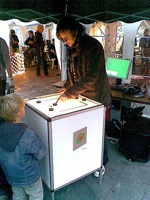
ConDio - Controlling Audio at RådhuspladsenAnyway, the first thing that grasped my eye was the ConDio, Controlling Audio. The ConDio is a device with which you can control the playback of sound, simply by moving physical bricks around on a table surface. The ConDio uses pattern recognition to determine the position of the different blocks, which translates into a specific function, for instance one brick changes the track that is being played, others applies filters.

It’s remarkably simple, efficient and intuitive to control a computer in this fashion, and it was a real crowd puller.

The ConDio has been developed by the medialogy branch of the University of Aalborg, and It was really great talking to the students that were responsible for the project. They were really feeding from the enthusiasm of the people that were looking at it.

I’m really envious that the students of today get to play with technology like this, to quote Haladjjan, the founder of Violet (manufacturer of the Nabaztag intelligent WiFi bunny):

“le début de l’internet a été une aimable kermesse… Maintenant les choses sérieuses commencent” – (translation: “the beginning of the Internet has been a friendly festival…Now the serious stuff begins”.

What a great time in history to be alive in.

Kim Bach – The failed scientist

I also enjoyed visiting the Bio Chemistry tent, where I had a discussion about how to bring science to the public (“videnskabs formidling”). The scientist in charge asked me it I’ve heard about Jens Martin Knudsen – and the regular reader would know that I just posted a tribute to him – we need more like him – since he was able to bring across complicated matters in lay-mans terms – we also discussed the great Richard Dawkins.

What I really hope is that someone could take up the reins from Jens Martin Knudsen, because we need those positive role-models from the scientific community to teach us the importance of understanding our world.

I also had a chance to redeem myself. I label my self a “failed scientist”. I’m really a product of the inspiration of the space program and the lunar missions, and when I was a kid, I desperately wanted to become a scientist – but “something” happened along the way – and it’s too complicated to talk about here – but I basically got fed up with boring educational system.

But it does seem like I have some basic scientific intuition, and I got some high marks from “the teacher” for thinking like a scientist, when I was observing the strange creature the Daphnia.

It was also interesting talking to the students from the Nano technology line. They’re looking into how to produce solar arrays that are less harsh on the environment, it turns out that you can use fruit juice from black berries as the base of a solar cell, instead of silicon – amazing.

Bend my circuits

But what I really enjoyed the most, was the tent dedicated to audio, which also included live performances from Dødskuglen, Rumpistol and Bjørn Svin (who I missed).

In the tent some interesting and simple demonstrators were set up, one was a Theremin that was controlled by a plant. You could actually play music by touching the leaves of the plant – very entertaining. Another was a tube with a number of nozzles from which gas could escape, and be lit, if you then played music, the sound-waves would modulate the flames – Daft Punk’s Robot Rock looked quite good “going up in flames”.

Dødskuglen plays with circuit bending, and they had gutted a lot of electronics with audio capabilities, for instance a couple of Furbys, that now looked – and sounded – like mean birds, and when you hooked them up to a keyboard, they were capable of making some wonderful noise.

Dødskuglen has their name from a dome shaped device, that is the center-piece of their show. According to them it’s filled with gutted electronics from Happy Meals and the like – I’m not surprised.

We also got a live demonstration of how to circuit bend – don’t try this at home – you might hit the AC power-supply and die – but if you’re careful, just take a cheap electronic keyboard apart, and try to apply some wire patches live – it was amazing to hear how the standard drum-machine suddenly went into a completely different state, and sounded completely different, only to return to it’s standard loop after being reset.

Kim Bach – The failed musician

After Dødskuglen, Rumpistol took the stage, and he’s using his computer in combination with analogue synthesisers to produce great electronica.

Besides being a failed scientist, I also consider myself a failed musician, but with the simple technology being showcased here, that is so much more fun and intuitive to control than a traditional instrument, I might be able to express myself – I know that I have some music in my head – maybe I can finally make some music – I know that I want a copy of the guitar simulator for the Nintendo DS called Jam Sessions.

A child’s mind

There’s a strange unifying synergy between science and music. When doing science and music, you really need to have a child’s mind, and like to play. That’s something I still, I’d say increasingly, possess – so I might still become a scientist/musician. It’s also noteworthy that a number of my heroes for instance RMS (Richard Stallman) and N (Peter Naur), actually play music themselves.

I went home after having had a great time, with renewed faith in our educational system, it seems to be producing playful scientists – I wished someone had told me that science was about playing, when I was a student.

I hope that Science After Dark will become a recurring event.

Show your <3 for science – make some NOIIIIISSSSSEEEEE!!!

I did, however, hear some rumours the Science After Dark has been frowned upon from the established scientific community. Come down from your ivory towers, Science is FUN and NOISY. Show your <3 for Science – make some NOIIIIISSSSSEEEEE!!!

Categories
Blogs Computere og Internet Education/Undervisning Hackers Historier/Stories Kim Blog (English) Mactopia Open Source Technology

Bad Penguin: “Linux – The OS I’ll – eventually – wear”: Kim Bach – still Mac user :-(

Bad PenguinClick here for the most popular videos

So I thought that Linux was ready for prime time, but not just yet – it was hurting my productivity too much :-(. I need some help setting my system up, and will attempt to get that when I soon will attend LinuxParty in Roskilde.

It did make for a couple of interesting Jaiku presense stream though (Kim Bach: Former Mac user and Installing Ubuntu on my new Lenovo V100 – Firefox on WiFi from the Live CD while my drive partitions. Have I died and gone to heaven?.

Performance of the applications is really great though, and I hit on one of the biggest obstacles, non-functioning DVD playback due to patent issues – really amazing that the International anti-thrust organisations haven’t looked into that :-(.

I hope to return to the Linux world soon, Ubuntu keeps improving

But the future really lies in simpler technology, and “the puck” is moving elsewhere than the monolithic computer. My mobile is increasingly my primary Internet access terminal, and Apple might just have got it right with the iPhone. The iPhone is actually much more Linux than people realise, it’s powered by FreeBSD and contains source code form from several open source projects, most noticeably KHTML which is the basis for the Safari browser.

Categories
Blogs Education/Undervisning Hackers Historier/Stories Kim Blog (English) Photography

“Angels” and “Demons” are lurking in your web-mail – kim.bach invites you to join Zorpia

Kim Bach: Pilgrim with an auraAccept my sincere apologies for spamming you with Zorpia invites

Zorpia is a spam-trap, so please DON’T register with the service.

I know that you used to trust me, but you shouldn’t trust me this time. Zopia are terrible people, but sometimes good things come from bad, so: